

(source)
First Amendment and FCC Regulations
The First Amendment grants all Americans their protected freedoms of expression, be it through religion, speech, press, assembly or petition. However, some of that protection is limited, especially through broadcast.
The Federal Communications Committee (FCC) regulates content broadcasted through radio and television. While the FCC and First Amendment rights protect broadcasts that highlight different points of views and stances, they have other limitations on speech. These restrictions ban: (1) inciting imminent lawless action and (2) obscene, indecent, or profane content. In order for material to be obscene, it has to “as a whole, [appeal] to the prurient interest,” “must depict or describe, in a patently offensive way, sexual conduct,” and “must lack serious literary, artistic, political, or scientific value.”
The restriction on obscene, indecent, or profane content was best exemplified by FCC v. Pacifica Foundation, also referred to as the “Seven Words You Can’t Say on Television” case. The seven words spoken by comedian George Carlin over a radio monologue were “shit”, “piss”, “fuck”, “cunt”, “cocksucker”, “motherfucker”, and “tits.” Someone who heard his monologue on the radio was in the car with their young son and found the content too obscene. They then filed a complaint to the FCC. When the FCC notified Pacifica Foundation (Pacifica) of the complaint, Pacifica pushed back and claimed that Carlin’s monologue was intended to be educational. Ultimately, the Supreme Court ruled that the FCC can regulate content like Carlin’s on the basis of indecency but not obscenity. If it had been obscene, they would have banned the content outright, but since it is indecent, it can only be restricted to certain hours.
These hours are the “safe harbor hours,” which are from 10 pm at 6 am. During those hours, “indecent” content can be played.
Cornell University’s Student-run Radios
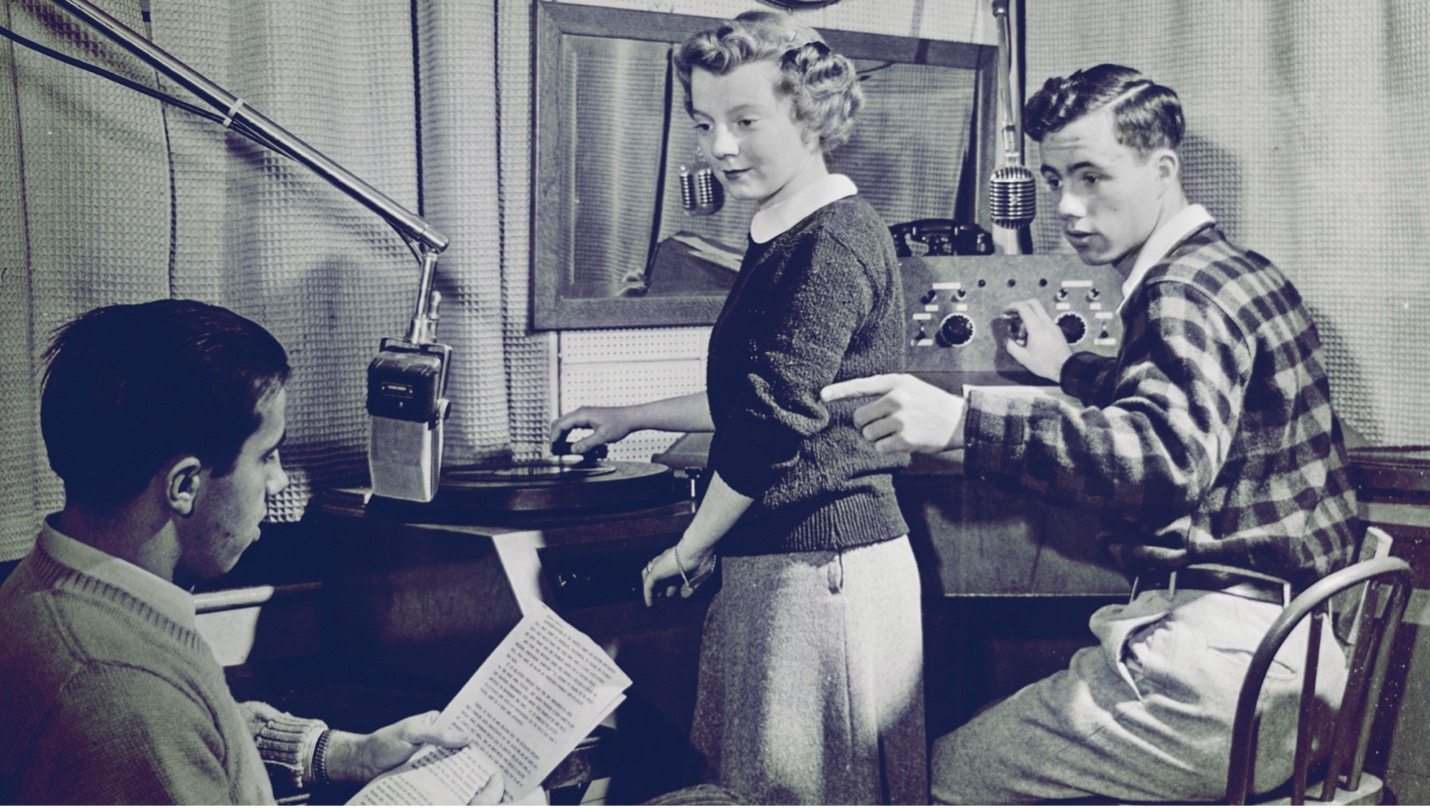
An example of usage of safe harbor hours can be best seen in WVBR (Voice of the Big Red), Cornell’s student-run radio station. Starting in 1935, WVBR (then an AM station WESG before changing to FM on 93.5 WVBR in 1940) played first a mixture of content, including sports, music, and entertainment, before becoming a classical music only station in the 60s. From the late 60s until 2018, WVBR shifted from contemporary rock, the top 40s, and “Real Rock Radio. Finally, in 2018, WVBR has evolved into “Ithaca’s Alternative,” which is their current format. While WVBR also has news and sports programming, it is best known for its involvement in the Ithaca music scene.
However, in recent years, WVBR has also introduced “WVBR After Dark,” which takes advantage of the safe harbor hours and allows for radio shows that not only stray from the alternative music that the station is most known for, but also has the freedom to play uncensored music.
However, another side of Cornell’s radio community that is not restricted by the FCC is Cornell Radio, another student-run station which broadcasts from cornellradio.net. Not only is Cornell Radio freeform and thus genre-less, but it also broadcasts only on the internet which is why it is not regulated by the FCC, since the FCC does not regulate online content. This means that Cornell Radio can play uncensored music or any other obscene, indecent, or profane content at any time of the day.
Why Is This Important Now?
Through various executive orders, the Trump administration is attempting to weaken the FCC’s independence and align the agency more closely to the Trump administration agendas. Already, the FCC has been limiting interviews from airing, by citing equal time provisions that were not previously enforced against late night talk shows.
In attempts to strengthen First Amendment rights and fight against censorship, perhaps the public should be pushing back on certain regulations imposed by the FCC. The easiest restriction may be the regulation on indecent language. Countries like France allow for music to play uncensored. And if content played over the internet can be played with no restriction, then why must radio content be restricted more strictly?
Another way to push back on current restrictions placed by the FCC would be by encouraging broadcasters who originally distribute through AM/FM radio or television to move towards online platforms, like Cornell Radio. Since the FCC does not control internet content, it can be considered a “safe haven” for what was previously considered obscene material. This does not protect the work against First Amendment claims, since obscene matter is not protected, but it does raise questions as to why swear words are not protected while hate speech is. It is by integrating formerly frowned upon language into new contexts that standards can be reassessed.
Analogous to the book ban debate, it should be argued that parents should be deciding what content their children listen to without limiting the speech of others. The government should not be controlling the type of content that can be accessed by the public. Now is a time for the public to ensure that their First Amendment rights are protected, and one way to do so may be to encourage people to take control of the content they listen to, while allowing for more leeway for the content itself.
Suggested Citation: Joyce Lian, What Cornell’s College Radios Can Tell Us About the First Amendment, Cornell J.L. & Pub. Pol’y, The Issue Spotter, (Mar. 19, 2026), https://publications.lawschool.cornell.edu/jlpp/2026/03/19/what-cornells-college-radios-can-tell-us-about-the-first-amendment/.
About the Author