

(Source)
While the days of manually winding clocks twice a year are largely behind us, the setback to standard time still makes itself known by disrupting routines and setting the sun unreasonably early. Overlapping with the evening commute, diminished daylight comprises visibility and increases the danger for drivers and pedestrians alike. Impacting accident trends is not unique to standard time. During daylight savings, accidents increase in the early hours—as workers embark on caffeine-fueled commute to the office and children head to school.
Year-round, drivers face heightened risks when the sun is out of sight. In fact, independent of whether clocks are set to standard time, “about half of traffic fatalities occur at night” despite nighttime driving constituting only one quarter of overall travel. The impact of poor lighting conditions on driving ability enlightens the seemingly sudden LED headlight infiltration over the past two decades. Installed in 76% of new U.S. cars in 2023, LED bulbs have largely replaced their predecessor: the halogen bulb. While halogen bulbs produce 900 to 1,000 lumens of light, LED bulbs produce from 3,600 to 4,500 lumens of light. About 60% brighter than halogens, LED bulbs “offer better road illumination,” emitting “more light, and a brighter bluish light than halogen bulbs.” Even more, automakers favor LED bulbs as “they are less expensive and considered more reliable, have a longer lifespan and use less energy.”
While LED headlights are indeed brighter, whether this difference ultimately equates to enhanced road safety is up for debate. As it appears, many drivers do not think so. As early as 2004, “about 30% of drivers experienced a ‘disturbing’ nighttime glare while driving.” More recently, new data shows LED headlights in particular concern drivers, with “almost three in five motorists (57 percent) believ[ing] LED headlights are too bright.”
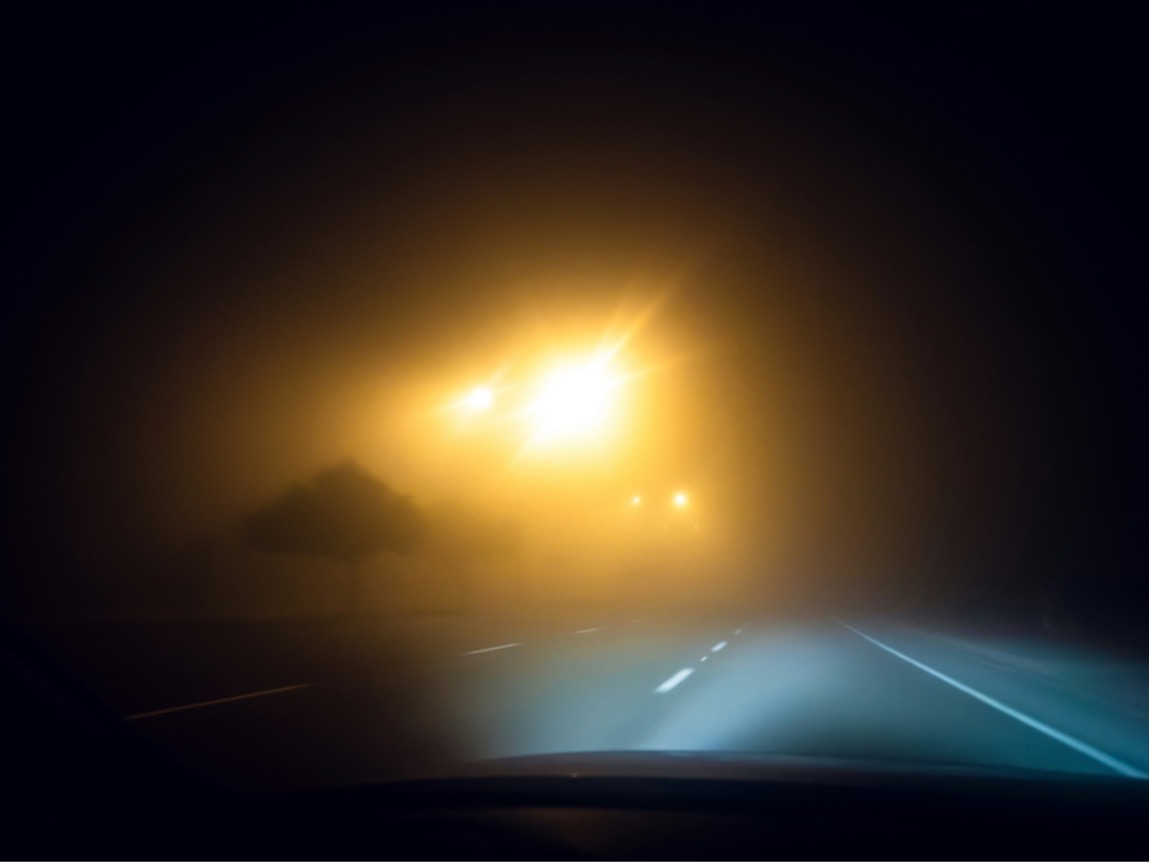
These concerns are not unfounded, as the increased brightness also produces more glare. According to the National Highway Traffic Administration (NHTSA), the increased glare of brighter headlights reduces other drivers’ visibility and creates feelings of discomfort—such as “the feeling of annoyance or even pain . . . [and] can distract drivers from the driving task, cause them to slow down, and cause drift slightly in their lane.”
Moreover, drivers with vision impairments experience even graver threat when facing an onslaught of dazzling light on a dark road. Astigmatism, for example, is the most common refractive error—with a 2018 study estimating astigmatism affects 40% of adults. Experiencing decreased vision quality and increased glare, in the age of unchecked LED headlights, nighttime driving for astigmatic individuals can often feel like closing your eyes and hoping for the best would be safer.
Likewise, NHTSA studies show the natural decay of cells leaves drivers over fifty seeing a greater “amount of scattered light compared to younger drivers, resulting in a brighter ‘veil’ over the scene” when facing glare. Factoring in increased driver discomfort, the NHTSA noted a potential connection to “poorer steering control, lane-keeping, and speed control.”
Beyond the inherent glare-creating capabilities of LED headlights, a variety of other factors exacerbate the visual interference. Firstly, “the rise in popularity of SUVs and other larger vehicles” contributes to reduced visibility, particularly for those driving lower vehicles. Higher off the ground, the light’s direction can aim “directly at the other drivers’ line of sight.” Secondly, bright LEDs piercing through the windshield of an oncoming vehicle can harm more than just other drivers. Sometimes confusing the bright headlights for high beams, in a misguided effort to indicate the perceived error, “oncoming drivers often flash their own high beams.” As a result, both drivers wind up sightless, driving directly towards one another down a dark road.
For those desperately seeking any semblance of relief from bright, blinding headlights: certain vehicle modifications can reduce glare. Firstly, maintaining a clean windshield, or installing anti-glare film can help reduce glare from oncoming vehicles. Drivers can also reduce glare from vehicles in the rear view “[i]n some vehicles, drivers can pull a lever under their rearview mirror to activate a night setting or “drivers can adjust their side mirrors down.”
Such solutions often fall short of satisfying—only providing minor relief from brutally blind headlights. Accordingly, more comprehensive and further-reaching solutions are necessary. For starters, the National Highway Traffic Safety Administration, responsible for setting headlight brightness requirements, does not impose “an overall limit on low-beam headlight brightness.” Currently, numerous test points for maximum headlight intensity have an infinite limit. As certain locations—including the middle of the headlight—lack limits completely, intensity limits do not regulate the headlight’s brightness in its entirety allowing for greater glare.
Albeit, an NHTSA spokesperson stated the agency recently received a rule-making petition, requestion the Agency consider setting an overall limit on the maximum brightness of low beam headlights—suggesting “20,000 candelas, or another value the NHTSA determines ensures the comfort, health, safety, and civil rights of any oncoming driver, pedestrian, bicyclist, wheelchair user, child, and all others,” while meeting federal requirements for protecting photobiological, neurological, psychological, and hormonal safety for Visible Light radiation emitted by an electronic product. However, the rule-making process can take two to three years before a suggestion is enacted as a rule. For instance, the NHTSA’s (soon to be discussed) 2024 adaptive headlight rule-making originally arose from Toyota’s 2013 petition requesting the option to equip vehicles with adaptive headlight systems.
However, a maximum brightness limit alone may not be the only solution. As the NHTSA notes, visibility and glare prevention are “twin safety needs.” Accordingly, harvesting as much as the increased visibility benefits of LEDs as possible while reducing glare for other drivers is the ideal. In many ways, the adaptive driving beam headlights other countries have offered for many years provide just that. Keeping high beams on at all times, the headlight’s internal sensors redirect light and decrease glare, “shap[ing] the light…rather than scattering it.” In doing so, the headlights still cover the road with a bright light, while creating “a pocket of dimmer light around the other vehicles.” As such, the driver retains a well-illuminated field of vision without blinding other drivers.
Although the NHTSA finally approved adaptive headlights in 2022, the technology has yet to emerge on the American market—well, not in functioning form, that is. Oddly enough, some American cars are in fact equipped with adaptive headlights—but due to the differences in the NHTSA’s regulations, “lack the software” for activation. However, some consumers are already starting to face confusion in the marketplace. In Shu v. Toyota, for instance, four Toyota RAV-4 purchasers filed a fraud complaint, alleging the accusedcar manufacturer provided written documentation indicating the RAV-4 premium package included adaptive headlights. Despite the feature’s absence from the vehicle, the plaintiffs cited marketing materials—ranging from brochures to website offerings. Dismissing the question on procedural grounds, the case gives reason to believe the regulatory gap may compromise consumers purchasing experience. Considering the expansion of advertising beyond geographical limits of local airwaves, and the added element of influencer marketing, companies have significantly less control over which materials consumers view.
This is largely a result of the NHTSA rulemaking setting forth requirements differing from those in other countries. Refusing to directly importthe Economic Commission for Europe’s regulations, according to the NHTSA, the European model’s road test inappropriate due to the testing the systems on various types of roads, at various speeds, in various specified traffic conditions produced subjective observations. In the U.S., instead of receiving blanket approval for certain product types, manufacturers must self-certify compliance. Accordingly, the Agency’sdescribedtests must be capable of consistently producing the same results. Instead, the NHTSA opted for track-test scenarios.
However, numerous major car manufacturing companies—including Toyota, Honda, Volkswagen, GM, and Ford—critiqued the proposed track test impracticability, with Toyota estimating “the proposal resulted in 10,000 possible test scenarios,” with several commenters further claiming “the proposal would necessitate testing capabilities beyond those available at existing testing facilities.”
Moreover, attempting to prioritize glare reduction over all else, exceeding the applicable glare limit for even .01 second constitutes a test failure—intended to ensure any excess glare is whole imperceptible to the human eye. Commenters, however, found this to be overly corrective. Toyota, for instance, commenting on the lack of clear evidence demonstrating the heightened standards “leads to a safety hazard any greater than what occurs with existing headlighting systems on U.S. roads today.”
Considering the added burden of self-certification and the added costs of adapting to a new testing standard while simultaneously updating the technology, automobile manufacturers face an uphill battle in developing sufficient adaptive headlights for American markets.According to auto industry sources speculate the NHTSA’s differentstandards demand years of redesigning efforts—requiring a completely new headlamp designs for the US.”
Whether it be through lobbying the NHTSA to make the adaptive headlight regulations easier and less costly, or lawmakers pushing for the NHTSA to impose a maximum brightness requirement, the increasingly prevalent difficulties with nighttime driving demand action. The brightness of LED bulbs should make streets safer, not more treacherous. While drivers can alleviate some glare through personal vehicle adjustments, the threatened safety of others demands greater attention. Although a maximum headlight brightness regulation may reduce some glare, ultimately advanced headlight designs which retain increased visibility but do not interfere with the well-being of others is seemingly the best way forward. Or perhaps we should just keep things simple, and line the roads with a few more streetlights.
Suggested Citation: Tay Rossi, Now You See Me: Bringing Down the Brightness of LED Headlights, Cornell J.L. & Pub. Pol’y, The Issue Spotter, (Jan. 30, 2026), https://publications.lawschool.cornell.edu/jlpp/2026/01/30/now-you-see-me-bringing-down-the-brightness-of-led-headlights/.
About the Author